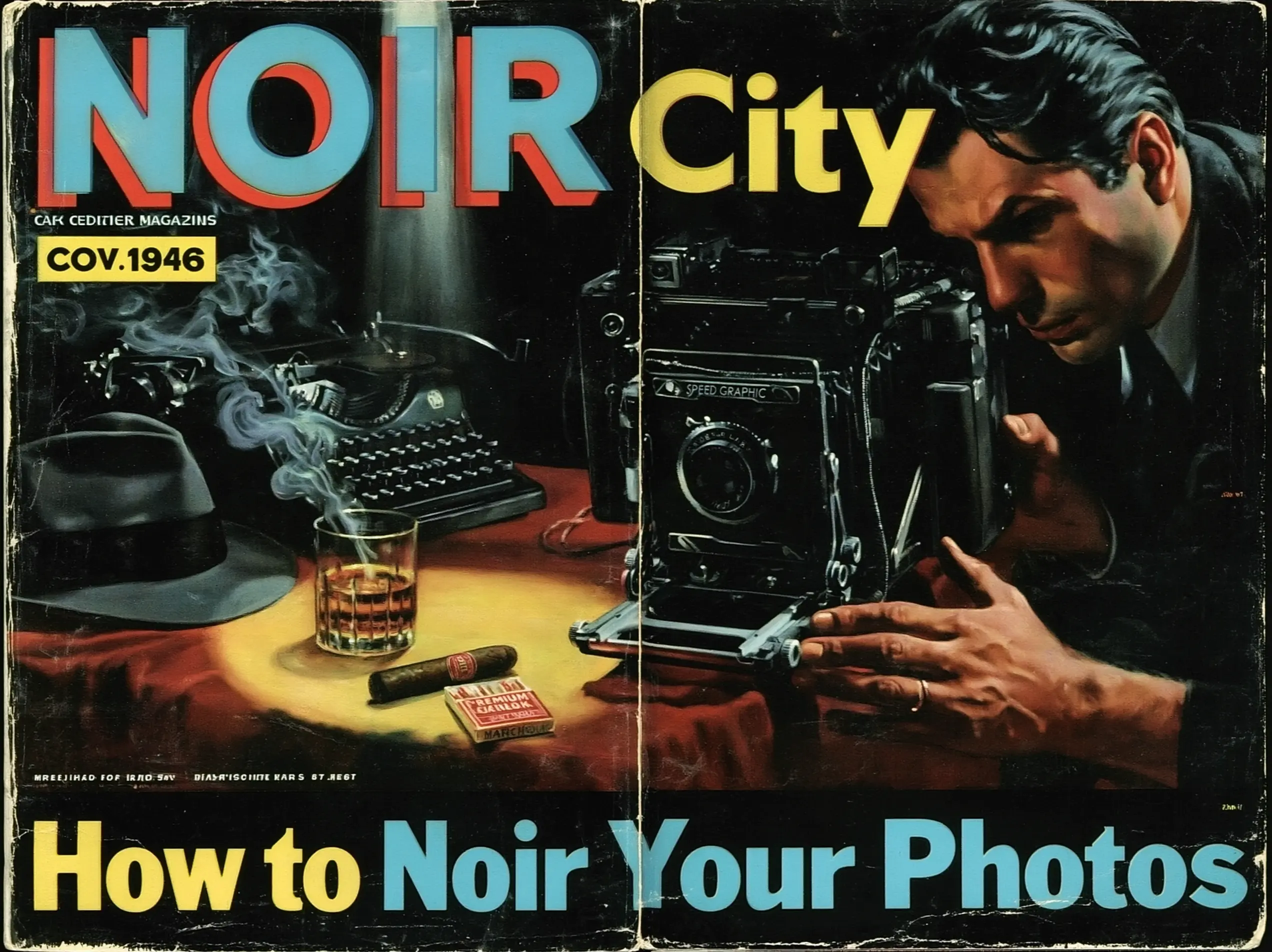
Every Shadow Is a Decision
Watson on light, shadow, smoke, and why your camera isn't the problem.
The District Attorney tossed the photograph onto my desk like it had just won him an election.
"I don't know how you do it, Watson."
I looked down at the picture.
Tommy "Two Toes" Moretti.
Half his face hidden beneath a fedora. One eye catching the light. Smoke curling around him like it had been paid to keep his secrets. Every wrinkle in his coat looked guilty. Every shadow looked like it knew his lawyer.
The District Attorney shook his head.
"My boys were there the same night. Same room. Same suspect. Their photographs look like somebody sneezed while holding the camera. Yours…" He tapped the print with one finger. "…looks like the jury was standing beside you."
I slid the photograph back across the desk.
"That's because your boys were taking pictures."
"I was collecting evidence."
There's a difference.
Most people think a camera records what it sees. It doesn't. It records what the investigator understands.
I've spent enough nights chasing crooked accountants, lounge singers with perfect alibis, jealous husbands, smugglers, crooked politicians, and more than one cigar that wasn't what it claimed to be. Somewhere along the line you stop taking photographs. You start gathering confessions.
There are six things I never forget when I'm holding a camera.
Ignore them if you want.
Just don't ask me to testify for your photograph.
"You don't need to fill the room with light. You need to know where to put it."
— Detective WatsonFirst — Respect the Light
People are always telling me my photographs are dark.
Nonsense.
They're full of light.
I just don't waste it.
A rookie walks into a warehouse and flips on every light switch he can find. That's not investigation. That's decorating.
A seasoned investigator knows a single streetlamp can identify a suspect better than a stadium full of floodlights.
One lamp across the face.
A neon sign bouncing off wet pavement.
The glow from a cigar just long enough to reveal a pair of nervous eyes.
That's all you need.
Darkness isn't your enemy.
Confusion is.
Light should introduce your suspect…
Not the wallpaper.
Second — Decide Who's Guilty Before You Press the Shutter
I once saw an investigator proudly show me a photograph he'd taken from the roof of a twelve-story building.
"There!" he said. "You can see everything."
Exactly. Everything. Except the fellow he was supposed to be following.
If I'm after Tommy Two Toes, I don't climb the Empire State Building and photograph a hundred thousand innocent people just to prove Tommy was somewhere down there.
Evidence isn't about how much you can fit into the frame. It's about what you leave out.
Every unnecessary lamp post.
Every extra chair.
Every wandering tourist.
Every distracted pigeon.
They all become defense witnesses.
Your suspect should own the photograph the same way a confession owns a courtroom.
If people have to ask who they're looking at…
You missed.
"Smoke should suggest mystery. Never erase it."
— Detective WatsonThird — Watch the Smoke
I know. Everybody expects smoke where I come from.
Truth is… smoke has solved almost as many cases as it has ruined.
Too much smoke hides the evidence.
Too little smoke makes the room look like a dentist's office.
The trick is knowing when smoke should whisper… and when it should testify.
Sometimes a ribbon of cigar smoke catches the light and suddenly your suspect isn't hiding anymore. Sometimes it wraps around a jazz singer and turns an ordinary stage into something worth remembering.
Other times… it turns Tommy Two Toes into Casper's older brother.
That's not atmosphere. That's incompetence.
Smoke should suggest mystery.
Never erase it.
Fourth — The World Is in Color. The Evidence Isn't.
People are forever asking why my photographs are black and white.
They aren't. Not when I take them.
Ruby still wears a red dress.
The whiskey still glows amber.
The evening sky still burns gold.
Fresh tobacco is still every shade of brown God ever imagined.
Neon still splashes blue across rain-soaked pavement.
That's the world I live in. That's the world everybody lives in.
But evidence has different rules.
When the photograph goes into the case file, color has a habit of arguing with the facts. Black and white settles the disagreement.
Without color trying to steal the conversation… the eye notices expression. Lines. Texture. Light. Fear. Truth.
You'd be surprised how honest a face becomes after color leaves the room.
Fifth — Don't Let Cleverness Destroy the Evidence
Some fellows get so excited about fancy camera tricks they forget they're supposed to identify the suspect.
Everything's blurry.
Everything's tilted.
Everything looks like it was photographed during an earthquake.
Very artistic.
Absolutely useless.
If Tommy disappears because you wanted to impress the photography club… congratulations. You've just helped organized crime.
Evidence isn't supposed to make people ask, "How did you take that?" It's supposed to make them say, "Well… that settles it."
Leave the magic tricks to stage magicians.
I'll stick with convictions.
"Wide. Close. Moving. Those three photographs tell the whole story."
— Detective WatsonFinally — Every Case Deserves Three Photographs
Only three.
The first tells me where we are.
The second tells me who matters.
The third tells me what happened.
Wide.
Close.
Moving.
The wide shot gives the jury the stage. The close shot introduces the actor. The moving shot proves he didn't stand there posing for a Christmas card.
Whether it's a crooked politician slipping out the back door… a jazz singer walking into trouble… a gangster climbing into a black sedan… or a lonely cigar burning itself into memory…
Those three photographs tell the whole story.
Miss one…
And you're asking twelve strangers to finish writing your report.
Never let a jury become your co-author.
The District Attorney picked the photograph back up and studied it again.
"I suppose I ought to buy a better camera."
I couldn't help smiling.
"No."
He looked puzzled.
"You need better eyes."
He stared at the picture another moment before slipping it back into the evidence folder.
"I'm glad you're on our side, Watson."
"So am I."
I've seen the other side.
They never know where to stand when the light finally finds them.
- Respect the light. One lamp placed correctly beats a room full of floodlights.
- Decide who matters before you press the shutter. Everything else is a defense witness.
- Watch the smoke. Too much hides the evidence. Too little kills the atmosphere.
- Black and white isn't about style. It's about removing color's argument from the facts.
- Cleverness that obscures the subject helps nobody. Evidence should settle things, not impress people.
- Every case needs three photographs. Wide. Close. Moving. Miss one and you need a co-author.
"You might as well dress the part."
Enter the Smoulder Shop →Until next time… I'm Detective Watson.
Noir Cigar™ — Lighting up the truth… one leaf at a time.