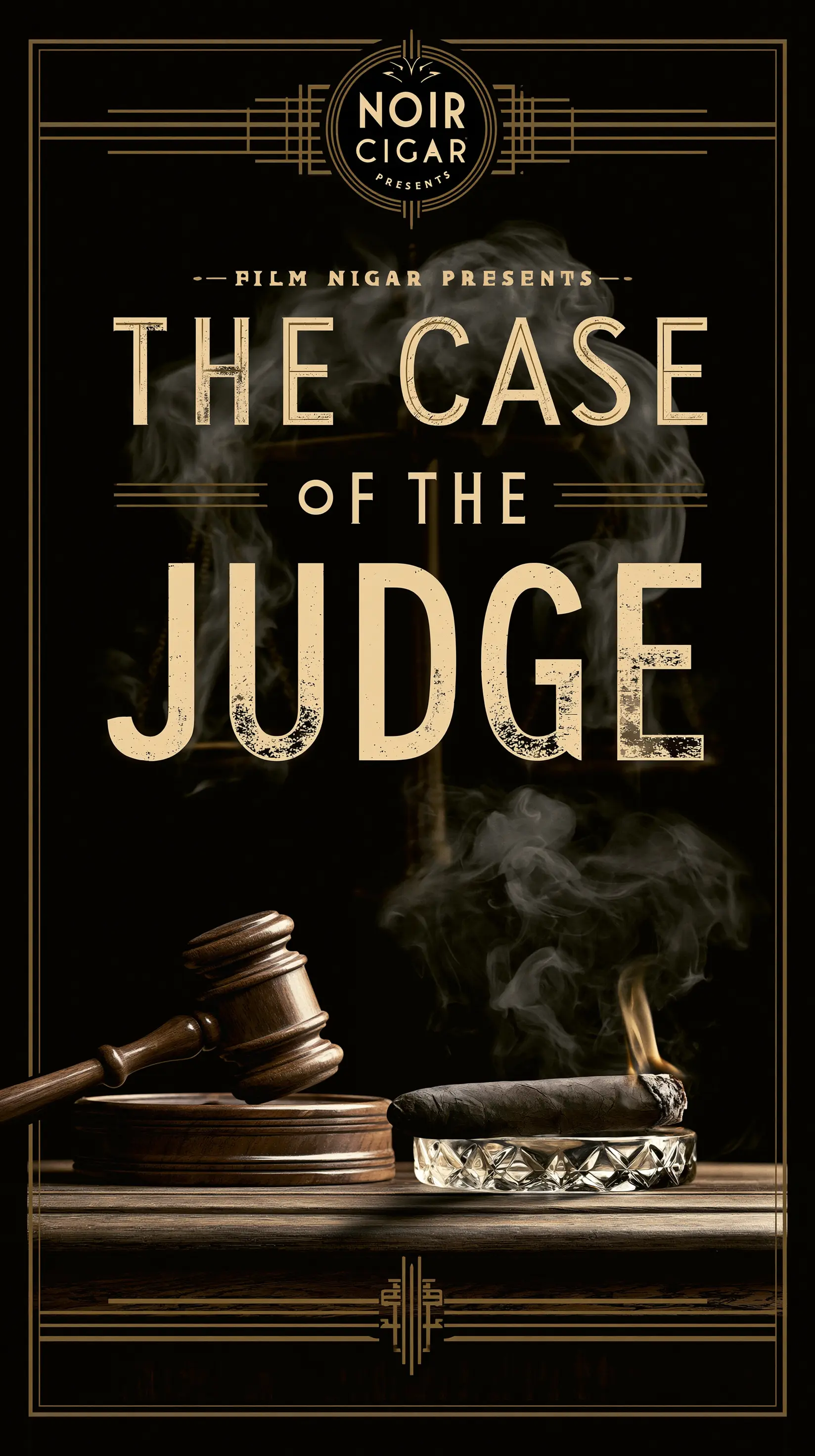
Some verdicts you see coming. Others walk in wearing a gavel and change everything.
I've argued with a lot of dames in this city.
Won a few.
Lost more than I'd care to admit.
But I've learned something after enough years in this business — the ones who don't argue back aren't agreeing with you.
They're already certain.
They don't need your opinion.
They've rendered their own.
She strutted in box-pressed and bold.
Not pretty-bold. Not trying-to-impress-you bold.
Authority bold.
The kind that doesn't ask for your attention so much as issue a warrant for it.
Five inches tall. Sixty ring gauge across. Built like a closing argument nobody in the room saw coming — wide, deliberate, and structured with the kind of precision that tells you somebody on the other side of this case has done their homework.
They call her The Judge.
I believed it immediately.
That Ecuadorian Sumatra wrapper stopped me before I ever reached for a match.
Dark. Oily. The kind of surface that catches light the way a courtroom catches silence — completely, and with intention. She wasn't dressed to be admired. She was dressed to be taken seriously.
A wrapper so dark and composed it looked less like tobacco and more like a verdict already written.
I rolled her slowly between my fingers.
Firm. Dense. Packed with the kind of quiet authority that doesn't announce itself because it doesn't need to. The construction was immaculate — no soft spots, no bumps, no evidence of shortcuts. Somebody had built this dame the way you build something meant to outlast the room it walks into.
I brought her close.
The cold draw told me the Nicaraguan filler inside was already awake and ready.
Earth. A whisper of cedar. Something darker underneath that I couldn't name yet but recognized the way you recognize trouble — not by its face, but by the feeling it leaves in the room after it sits down.
She wasn't hiding anything.
She simply wasn't ready to tell me everything yet.
There's a difference.
The foot toasted evenly.
No coaxing. No babysitting. No uneven hot spots demanding my attention before the investigation had even properly begun.
She lit like someone who'd rehearsed this moment and found it beneath them to be nervous about it.
First draw.
The gavel came down.
Red pepper — immediate, sharp, present — arrived like an opening statement that grabs the room before anyone's fully settled in their seat. Not brutal. Not the kind of pepper that makes you wonder what you've gotten yourself into.
The kind that says pay attention.
This matters.
And then — before I could object — dark chocolate walked through the door and changed the entire atmosphere of the room.
Red pepper slammed the gavel up front, but before I could object, she sweet-talked me with dark chocolate, cedar, and a kiss of cream that arrived like a surprise witness nobody saw coming.
I leaned back.
Reset.
Reconsidered the opening argument entirely.
Good detectives know when they've been outmaneuvered.
I'd walked into this investigation expecting force.
What I found was strategy.
Because that's the difference between a cigar that's simply strong and a cigar that's genuinely complex — one of them hits you and waits to see what you do about it. The other hits you, watches your reaction, and then does something completely unexpected while you're still processing the first move.
The Judge did the second thing.
Every time.
The cedar arrived next.
Not the sharp fresh-cut lumber cedar that announces itself by filling the room. Old cedar. The kind that lives inside a humidor that's been kept by someone who understands patience — warm, quiet, worn smooth by years of doing exactly what it was built to do.
Then cream.
Which I did not expect.
That's the thing about a great Nicaraguan blend built by people who know what they're doing. The strength is real. The complexity is real. But underneath all of it, if the tobacco has been aged properly and the blend has been thought through rather than assembled — there's a smoothness that shouldn't be there by any reasonable logic, and yet somehow is.
Like finding a velvet chair in a precinct interrogation room. No reason for it to be there. Completely unwilling to apologize for itself.
The second third is where witnesses reveal themselves.
She'd made her opening statement in the first third. Bold. Structured. Impossible to ignore.
Now she started calling witnesses.
Hazelnut arrived quietly.
The kind of flavor that doesn't wave at you from across the room — it taps you on the shoulder and waits for you to turn around. By the time I'd confirmed what I was tasting it had already been there for several draws, doing its work without asking for credit.
Coffee followed.
Not espresso — not that sharp concentrated punch. Something more like a cup that's been sitting on a desk in an office where someone's been working too long on a case they can't quite close. Present. Warm. Slightly past its peak and all the more honest for it.
And then toasted graham cracker drifted through.
I sat with that one.
Because that's not a flavor you expect from a cigar carrying this much authority. Graham cracker is a gentle note. Almost domestic. The kind of thing that makes you reconsider the whole profile — makes you realize that behind all that structure and strength and courtroom composure, there was something almost warm in there.
The dame with the gavel has a grandmother's kitchen somewhere in her past.
She didn't advertise it.
I only found it because I was paying attention.
Sometimes the most important evidence isn't what's on the desk.
It's what's in the drawer.
By the time plum showed up for cross-examination I knew I was done for.
Plum.
Dark, ripe, faintly sweet — arriving in the final third like a witness the defense didn't know the prosecution had. Black pepper returned alongside it, sharper now, more present, the way the truth tends to get louder as you get closer to the end of any case worth working.
She didn't soften toward the finish.
She resolved.
There's a difference.
Softening is what happens when a cigar runs out of things to say and starts hedging. Resolving is what happens when everything that came before it locks into place and the whole story suddenly makes sense in a way it couldn't have in the first act.
The Judge resolved.
Completely.
Confidently.
Without a single apology for anything she'd put me through to get there.
They said she scored a 98.
Named the number one cigar of 2024.
I don't usually put much stock in what the press says. I've seen too many verdicts reversed in this city to trust a headline.
But this time.
The ink got it right.
And at thirteen dollars and change — she's practically doing pro bono work for the premium cigar world.
Don't tell her I said that.
She doesn't strike me as the type who'd appreciate the implication that she could charge more.
The burn stayed razor-straight from first light to final inch.
No corrections needed.
No relights requested.
The smoke — thick, rich, rolling — arrived in volumes that filled the room with something between atmosphere and evidence. Nicaraguan earth running underneath all of it like a current you don't see but feel in every draw.
This isn't just tobacco.
This is testimony.
I looked at what remained.
Thought about the session.
Thought about the pepper that opened the case and the plum that closed it and all the witnesses in between who showed up exactly when they were needed and said exactly what needed to be said.
Some cigars earn your respect by being expensive.
Some by being rare.
Some because everyone else decided they should.
The Judge earned hers the only way that ever actually matters.
She proved it.
Draw by draw.
Inch by inch.
Without once asking whether you were keeping up.