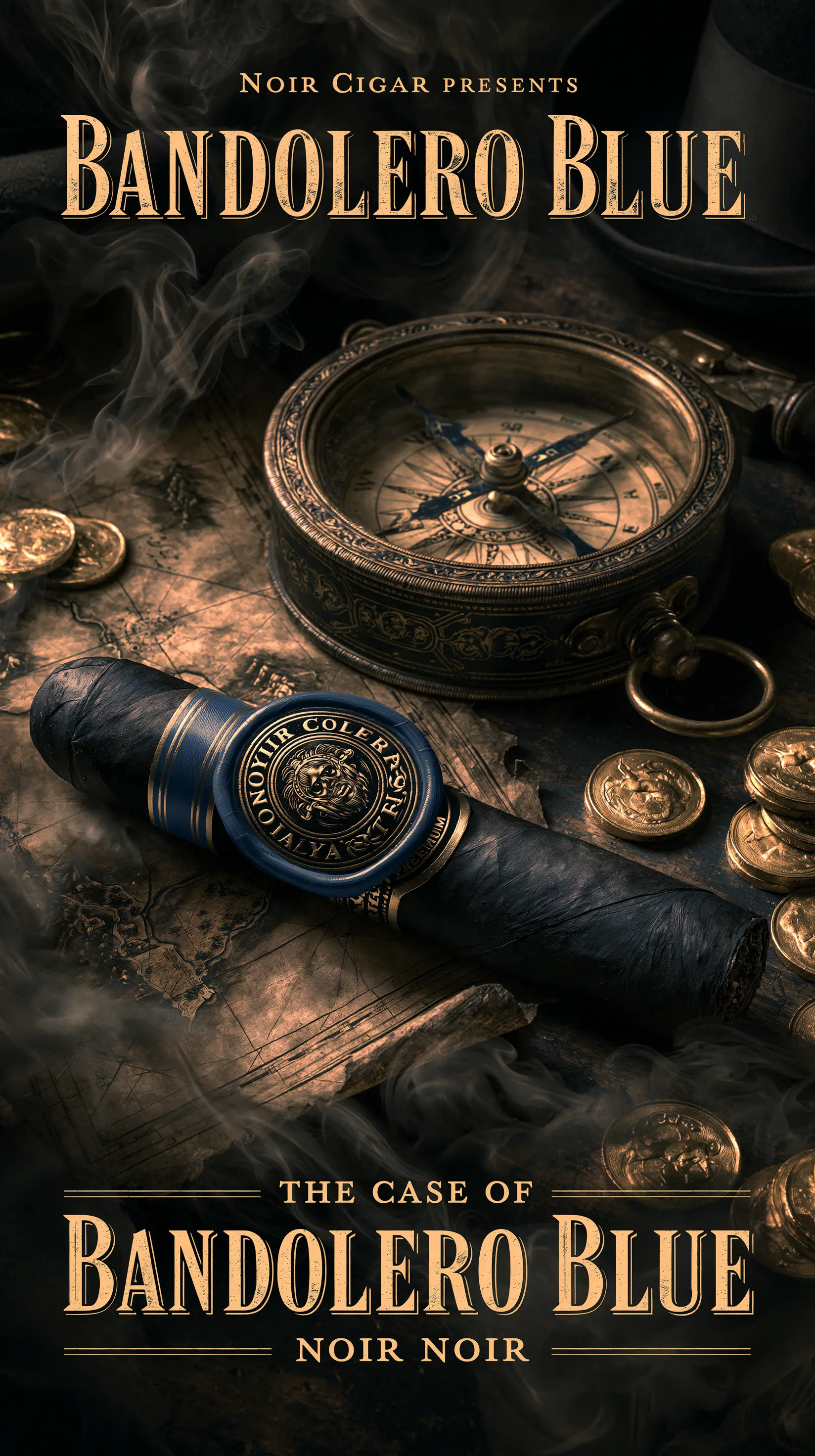
Some dames carry secrets. This one carried a criminal record. And wore it like an evening gown.
The city had been quiet for three days.
Too quiet.
The kind of quiet that doesn't mean nothing is happening. It means everything is happening somewhere you're not looking yet. I'd learned that lesson the hard way somewhere between my second posting overseas and a very complicated Tuesday in a port city I'm not at liberty to name.
I was at my desk. Case files stacked. Bourbon poured. The humidor sitting against the far wall like it always does — patient, unhurried, full of suspects who knew better than to rush a man who was still thinking.
That's when I found her.
Tucked in the back.
Like she'd been waiting there long enough that she'd stopped expecting to be noticed and had simply made herself comfortable in the dark.
They call her Bandolero Blue.
I picked up the file.
Started reading.
And that's when things got interesting.
Because this dame didn't just have a history.
She had a bloodline.
Descended from the smugglers who slipped tobacco past the king's taxmen when tobacco was contraband and the penalty for getting caught was considerably more severe than a fine and a stern conversation. These weren't romantic outlaws playing dress-up in stolen coats. These were operators. Professionals. People who understood that the most valuable things in the world are always the ones somebody powerful has decided you're not allowed to have.
She walks in wearing history like a stolen dress.
And the fit is perfect.
Not because she's trying to intimidate you with her heritage. But because the heritage is simply there — woven into the wrapper, pressed into the construction, present in every draw the way old money is present in a room without anyone having to mention it.
You just feel it.
And you adjust accordingly.
Now here's where the investigation took a turn I wasn't expecting.
Because behind this dame is a man.
Nelson Alfonso.
And if that name doesn't stop you cold then you haven't been working cases long enough to know what it means. Alfonso is the architect behind Atabey — one of the rarest, most sought-after cigars in the world. A dame so exclusive she makes other exclusive dames feel like they're standing in the wrong line at the wrong club on the wrong night.
He also built Byron.
Between those two creations Alfonso had established himself as a man who operated at a level most blenders spend entire careers trying to reach and never quite get to.
And then.
Then.
He built the Bandolero Blue.
At thirteen dollars.
Fourteen on a bad day.
I sat with that for a long time.
Because in my experience when a man of that caliber makes something affordable it isn't charity. It isn't a side project. It isn't him clearing out the warehouse on a slow Friday afternoon.
It's a statement.
It's a man looking at an industry that keeps building walls and deciding — quietly, without announcement — to leave a door open.
That's the kind of move that deserves investigation.
So I investigated.
She came in at four and a half inches.
Fifty-four ring gauge across the waist — short, curvy, and built the way things get built when the architect has stopped caring about what impresses people and started caring exclusively about what works.
Like a getaway car designed by a Formula One engineer. Nobody asked for it. Nobody expected it. And yet here we are.
I turned her slowly under the desk lamp.
That Ecuadorian Habano wrapper caught the light without asking it to. Dark. Smooth. Brushing the very edge of Maduro the way a dame brushes the edge of a room — close enough to the danger to make you notice, composed enough to make you wonder if you imagined it.
Beneath the gown — a Peruvian binder.
Now.
I want to stop here.
Because nobody talks about Peruvian tobacco. It doesn't get the headlines. Doesn't have the mythology. Doesn't show up in the conversations that happen in the back rooms of serious humidors between people who think they know everything worth knowing.
Which is exactly why it deserves attention.
Peruvian tobacco is the quiet one in the room.
The one who's been listening to every conversation all evening and hasn't said a word yet — and when they finally speak, every other voice in the room goes silent without knowing quite why.
The Peruvian binder here isn't trying to dominate anything.
It's holding everything together.
Like the kind of person who never gets credit for keeping the whole operation running — until the one day they don't show up and suddenly nothing works and everyone finally understands what they had.
Beneath that — Nicaraguan and Peruvian fillers cinched together like secrets tucked into silk stockings.
Nobody getting out until she decides it's time.
I brought her close before the flame arrived.
Let the wrapper introduce herself first.
Something dark and sweet drifted up — the kind of aroma that doesn't announce a flavor so much as announce an intention. Like the first few bars of a jazz standard played low in a room where the lights have already been turned down and everyone present has already agreed that whatever happens next is between them and the evening.
The cold draw confirmed it.
Cocoa.
Leather underneath.
A spice already sharpening itself in the background like a stiletto heel clicking down an empty hallway at midnight — you hear it before you see it and by the time you see it the decision has already been made.
I lit her with a soft flame.
She didn't flinch.
Didn't require ceremony.
Didn't need to be coaxed or convinced or told that this was a safe space to be herself.
She simply caught and began.
Like she'd been ready for this conversation long before I was.
First kiss.
Cocoa laced with midnight sin.
That's not a tasting note. That's a warning.
Soft leather whispered across the lips next — not the sharp aggressive leather that some Nicaraguan blends use as a calling card, the kind that announces itself by taking up more space than it was invited to occupy. This was worn leather. The leather of a jacket that's been broken in over years of actual use. The leather of something that has been somewhere and done something and isn't interested in telling you about it unless you ask the right questions.
Then the spice arrived.
Quick. Sharp.
Like a stiletto heel on a wet street at two in the morning — you felt it before you fully processed what happened and by then she'd already moved on.
I leaned back.
Reassessed.
Because here's what I was expecting from a dame with outlaw blood and a criminal pedigree and a name that references the smugglers of the old tobacco trade.
I was expecting chaos.
I was expecting a dame who'd grown up rough and never quite lost the edges.
What I found instead was something that surprised me more than chaos ever could.
Poise.
She stayed balanced through the entire first third.
Not the balance of something that has been restrained or blended into submission — the balance of something that was simply designed correctly from the beginning. The way a well-built bridge doesn't strain against the weight it was built to carry. The way a good argument doesn't raise its voice because it doesn't need to.
The cocoa never disappeared.
The leather stayed present without becoming dominant.
The spice offered heat without demanding surrender.
Three witnesses. All of them telling the same story. None of them contradicting the others. That's not a coincidence in an investigation.
That's a confession.
The retrohale stopped me completely.
Leather and shadow.
That's the only way I know how to describe it and I've been trying to find better words since the first draw and I've decided better words don't exist. Leather and shadow. Bold enough to haunt your overcoat long after she's gone. The kind of retrohale that doesn't ask whether you're ready and doesn't apologize if you weren't.
It simply arrives.
Does what it came to do.
And leaves you slightly different than it found you.
I've met operatives like that.
In rooms I can't describe in cities I can't name on assignments that technically never happened.
The Bandolero Blue had that same quality.
She was brief. She was complete. And when she was done with you, you understood something you hadn't understood before — you just couldn't quite say what it was.
The second third is where the most complicated dames usually show their hand.
They can't maintain the mystery indefinitely. Nobody can. The smoke gets warmer, the draw gets shorter, the distance between who they presented themselves as and who they actually are starts to close whether they want it to or not.
She chose a different approach.
She stayed exactly who she'd been from the first draw.
Steady.
Loyal.
Dangerous enough to keep you guessing without ever being reckless enough to lose you.
The balance deepened rather than shifted. The cocoa became richer without becoming sweet. The leather became more present without becoming aggressive. The spice built slowly and carefully the way pressure builds in a room where everyone is being very polite and nobody is saying what they actually mean.
The finish arrived creamy.
Like the last word in a late-night argument you didn't win — smooth, composed, and somehow more satisfying than winning would have been.
I want to talk about her performance because in this business character and performance are two different investigations and both of them matter.
She burned straight.
The whole time.
Like a dame who never stumbles no matter how slick the pavement — and I've seen slick pavement, literal and otherwise, in enough cities to know that not stumbling when the conditions are against you is a skill that most people don't develop until they've already fallen down enough times to learn from it.
The ash stacked clean and pale grey.
Clinging past an inch like a lover who won't let go even after the conversation has ended and the room has gone quiet and there's really no practical reason to stay except that leaving feels like admitting something neither party is ready to admit.
The draw?
Easy.
Seductive.
Smooth as a swindle you didn't see coming and wouldn't have avoided even if you had.
Every puff poured smoke thick enough to hide the truth.
She never once made me strike a match twice.
No tantrums.
No games.
No dramatic third-act reversals designed to remind you that she could make your life difficult if she chose to.
Just steady company, from the first spark to the nub.
In a world full of dames who mistake drama for depth, that kind of steadiness is its own kind of extraordinary.
When the case finally closed I sat for a while without moving.
Thought about Nelson Alfonso.
Thought about the decision he made — the quiet, deliberate, almost subversive decision to take everything he knew about building something exceptional and put it inside something that costs less than a decent lunch in a city that charges too much for everything.
Thought about the smugglers in her bloodline who understood that the best things in the world have a way of finding the people who deserve them regardless of what any authority has decided about who should have access to what.
She's not the most complicated dame I've ever tailed.
She knows that.
Doesn't care.
Because complicated and memorable are not the same investigation.
And this dame — short, curvy, dressed in a stolen history and a Peruvian secret — turned out to be one of the most memorable cases I've worked all year.
Thirteen dollars.
Fourteen on a bad day.
She's practically doing pro bono work for the humidor.
Don't tell her I said that.
She doesn't strike me as a dame who appreciates being underestimated.
Even by me.
Especially by me.